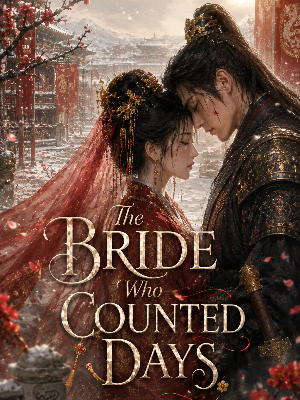
I sat still for a long time.
In my trade, when a customer names an absurd price there are only two possibilities: either he knows nothing, or he knows something I don't.
Pei Yan did not look like a man who knew nothing.
"Say it plainly." I pushed the pin into the middle of the table. "I'm a merchant. Merchants don't care for riddles."
He picked the pin up and turned it once in his fingers.
"Three years ago my father died at Wangsha," he said. "The court says he was rash. So does the capital. You'll have heard it."
"I've heard it."
"I was there."
I went cold.
"Seventeen years old, out at the pass with him, holding the lowest post in the army. I copied the supply ledgers." His voice was level, the way you'd tell a story about someone else's family. "That night they came over the wall. I was standing on the rampart, looking down."
He paused.
"Do you know the sound an arrow makes when it strikes armor?"
I shook my head.
"A knock," he said. "Like tapping on a cooking pot."
The dragon-and-phoenix candle spat once.
"I stood on that wall and listened to it all night." He set the pin down, very gently. "Knock. Knock. Knock."
"By morning my father was dead. Three thousand men were dead. The court set down four characters, and the whole capital went to bed comfortable in the knowledge that some old fool of a general had got his own men killed."
I didn't answer.
I sat there and did the one thing I have done my whole life.
I did the arithmetic.
We take military armor in pawn all the time — every year some fallen sword-officer's family carries in their ancestor's gear. I know what a set is worth. I know what good iron costs over soft. I know what proper quenching adds in labor.
Swap good iron for soft, and you eat seven parts in ten of the price.
Multiply by three thousand.
It came to a number I have never written in a ledger.
"The money was real," I heard myself say. "Only the goods were false."
"I copied the supply ledgers that year," he said. "Not a coin short."
I sat with my hands resting on the table.
I grew up among forgeries. I have been catching them since I was eight. To me a forgery was a game — someone tries to fool me, I don't let them, and that's all. When I caught one I'd be pleased with myself and tell my father about it all evening.
It had never once occurred to me that a forgery could kill a man.
Much less three thousand of them.
"So you sold the house." I said it slowly, my head starting to move again. "No. That's wrong."
I looked up sharply.
"If you needed silver to chase this, you'd sell the real things and be done. Sell them, leave the walls bare, and tell anyone who asks that you're broke — which fits your reputation perfectly. Instead you spent more money putting forty-one forgeries back into the gaps. That makes no sense."
"Unless," I said, "you weren't selling for the silver."
Pei Yan looked at me. One corner of his mouth went up.
"Go on."
"You were selling to trade," I said. "Trading for something else. A painting buys you what? A statement? A name? A page of a ledger?"
I looked around that room, and for the first time in my life a heap of forgeries made my back go cold.
"People see you selling and assume you need money. But if anyone were counting which pieces you'd sold — which vase, which painting, which month — then by following the object they'd find out who you'd traded with."
I looked straight at him.
"So you put copies in the gaps. Not to fool the outside. The outside knows perfectly well you're selling everything you own."
"You're fooling someone inside this house."
Pei Yan said nothing.
Then he clapped, twice. Very slowly.
"In three years," he said, "you're the first."
"How many of them are in here?"
"I don't know." His answer was flat. "I only know there are some. Six months ago I traded a set of jade cups for the whereabouts of an old army physician who laid out the dead at Wangsha. Three days later he drowned in a pond that came up to my knee."
I shivered.
"Then why marry me?" I asked it straight out. "The capital's full of people who can read an object. Full of old shop managers with forty years in the trade."
He didn't answer at once.
He got up, took the blue-and-white vase off the shelf and set it on the table in front of me.
"You say this is false."
"It's false."
"I've looked at it for three years," he said. "I walk past it every day. I don't see it."
I raised my head.
"I know what the man who killed my father stood to gain. I know how many hands the money passed through. I know every figure in that year's supply ledger by heart." His voice stayed level, but there was something very thin running under it. "Put a real piece of armor and a false one in front of me, and I cannot tell them apart."
"I'm chasing a crime made out of forgeries — and I'm blind to forgeries."
He looked at me.
"I don't need an old shop manager. Every old shop manager has a master, a shop, grandchildren — something to take hold of. I need someone the whole capital regards as a pawnbroker's daughter, bought for a drunkard to spend her dowry on."
I understood.
The whole marriage, from the betrothal chests to the false pin in my hair, was a board he had set out in advance.
And I was the piece that had just been put down.
I breathed in and pushed the anger back down my throat.
"You lied to me," I said. "You laid out a trade and let me sit there thinking I'd come out ahead. I explained the arithmetic to my father. I told him it was a bargain."
"I didn't lie," he said. "You wanted a signboard nobody would dare take down. I gave you exactly that. I paid honestly."
"You knew what I wanted?"
The corner of his mouth curved.
Then he said something that turned my blood to water from crown to heel.
"Su Zhen. Three years ago your father's One Word House took in a very strange piece of merchandise. Not long after, your father lost his eyes."
I came out of the chair.
"You—"
"Sit down," he said, without raising his voice. "I'm not threatening you. I'm going to show you something."
He went to the writing table, pulled out the bottom drawer, and took out a bag of coarse cloth.
He set it on the table and opened it.
Inside was a plate of armor.
A curved shard of iron the size of a palm, its edge broken away, the black lacquer on the outer face flaking off in patches.
"Price it," he said. "My lady."
I gave him a look.
Then I sat, drew the candle close, and picked it up.
Light. Absurdly light.
I tilted it, tapped it with a fingernail — a dull sound, no ring. Soft iron. I ran a fingertip along the broken edge: coarse grain, pitted, badly quenched.
The black lacquer on the outside was three times as thick as service lacquer. Thick lacquer makes a thing look properly black, properly heavy to the eye. You don't lacquer armor to make it pretty. You lacquer this armor to hide it.
"This isn't armor," I said. "This is a cooking pot rolled thin, painted black, and sold to men who were about to die."
It was only after I'd said it that I remembered he had used the same word.
Pei Yan didn't point it out. He only watched me, and for one very short moment I saw him close his eyes.
I turned it over to look at the rivets.
Then I froze.
On the inner edge of the plate, in the most hidden place there is — the place that would lie flat against a man's ribs where nobody could ever see it — there was a mark.
Small as a needle's head.
One horizontal stroke. Three dots beneath it.
I brought it up to the candle. My hands began to shake.
There was no mistaking it. I have cut that mark my whole life; I've worn out my wrist cutting it.
My great-grandfather devised it when the One Word House first opened: every piece that comes in gets a sunk mark in a hidden place. The stroke is the character one. The dots beneath are the year.
Three dots.
Three years ago.
"This..." My voice had gone to nothing. "This was in my father's shop."
I looked up at him.
Pei Yan showed no surprise at all.
He had been sitting there with his hands folded, waiting for me to turn the plate over — waiting from the beginning.
"I know," he said.
"That's why I married you."