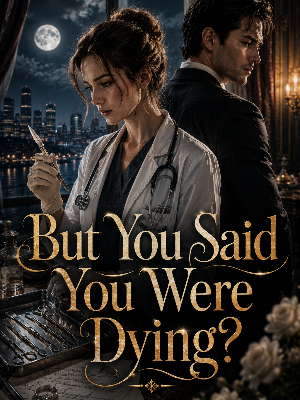
Three years before I married him, a man died holding my hand and told me I was already spoken for.
I didn't understand it then. I filed it under the things dying men say, which is a large file, and I have read all of it.
He came into the trauma bay a little after two in the morning, no name, no wallet, no phone. Two rounds to the chest and one that had gone through the meat of his shoulder and kept going. The paramedics had found him on the pier with the tide coming in around his boots, and he smelled the way the water smells down there — salt and diesel and something colder underneath, like the inside of a freezer that's been switched off for years.
We worked him. You always work them. That's the job — you stay in the room after everyone else has decided how it ends.
His pressure was a rumor. His eyes kept finding the ceiling and then finding me, and on the third or fourth time they found the badge clipped to my scrubs, where it says my name in letters big enough for a frightened person to read.
- QUINN, RN.
Something moved in his face. Not fear. Recognition. As if my name were a door he'd been told to watch for.
"Quinn," he said. It wasn't a question.
"Don't talk," I said. "Stay with me. Look at me."
His hand came up off the table and closed around my wrist, and it was strong, much stronger than a man with that much blood on the floor had any right to be. Not grabbing. Holding. The way you hold something you've been asked to deliver.
"You're the Quinn girl," he said. Blood in the words now, a wet edge. "He kept his—" A cough took the rest. I leaned in. His mouth worked. "—kept his word, then. All this time. He's still—"
"Who?" I said. "Who's still what?"
The monitor made the sound the monitor makes.
We ran the code for twenty-six minutes. I called it myself, because someone has to, and because I was the last person he'd looked at like I mattered and it felt wrong to hand that off.
There was nothing in his effects. No ink on him but one small mark inside the left forearm, a shape I didn't know yet — a bird, wings folded, done in a line so fine it might have been a scar that learned to be a drawing. The detectives came and went. John Doe, they wrote. Probable narcotics. Probable settling of accounts. The city is full of piers and the piers are full of men who wash up owing someone.
I went home and I slept badly and I forgot him, the way you have to forget them, or you'd never go back in.
I forgot the salt and the diesel and the freezer-cold underneath.
I forgot a stranger telling me I was the Quinn girl, and that a man I'd never met had kept his word about me all this time.
I would remember all of it later. I would remember it in a house on the water that smelled exactly the same, standing in a doorway I'd been forbidden to open, looking at the man I'd married.
But that's the end of the story.
The start of it is money.
It's always money.
I can keep a stranger alive with my hands. I've done it in elevators and stairwells and once in the back of a taxi with my knee in a man's sternum. I know the exact weight of a human life measured in compressions per minute, in units of blood, in the number of seconds a brain will forgive you before it stops forgiving.
What I cannot do is pay for it.
That's the part they don't tell you in nursing school. You learn to hold the line between a body and the dark, and then you go down two floors to a beige office where a woman with a lanyard slides a sheet of paper across a desk, and the paper is the real line, and it is not on your side.
My mother's paper said $214,000 and change. The change is what I remember. As if the hospital wanted me to know they'd been precise about it.
Ovarian, stage three, the kind that plays dead and comes back angry. She'd been in remission for eleven months when it walked back in through a door I thought I'd locked. Now she needed a drug that cost more per month than I made in three, and a surgeon whose calendar I could not afford to be on, and a bed in a facility where the carpet doesn't smell like the end of things.
I had a nurse's salary and a second job doing home care on my days off and a savings account I'd already turned inside out. I had, that Tuesday, a coffee going cold in my hand and a lanyard woman telling me, kindly, that there were programs, that we could set up a plan, that many families in my situation—
"I'm not many families," I said. "I'm one nurse. Tell me the number that keeps her breathing and I'll tell you it's impossible, and then we can both go back to work."
She had the grace to look tired with me.
I brought my mother her coffee — two sugars, she's taken it two sugars her whole life, even now when everything else tastes like tin — and I sat on the edge of the bed and I did what I do. I made it look survivable. I told her the surgeon was excellent. I told her the drug was working in trials. I told her I had it handled, which is the oldest sentence in our family and the least true, and she took my hand and told me I looked thin, and we sat there lying to each other because we love each other and that's what it looks like sometimes.
The man came to me two days later, and he did not come like money usually comes.
Money comes with a lawyer. Money sends a card. I was ready for a card.
Instead a nurse manager pulled me off the floor at the end of a fourteen-hour shift and told me someone was waiting in the family consult room, and there was a look on her face I didn't have a name for yet — the look people get around very large amounts of very quiet power.
He was standing when I came in. He didn't offer his hand.
I knew who he was the way you know a landmark. Everyone on this coast knows the Vosses. Voss Group is the reason half the container ships in the harbor have a reason to be there; it's on the sides of the cranes and the sponsorship banners at the children's hospital and the small brass plaque on the wing where my mother now lay. Damian Voss ran all of it, and the papers called him the Iceman of the North Sea, and they ran the same three photographs because he did not give them new ones.
The photographs were wrong. They made him look cold in a way that suggested absence, a man with nothing behind the eyes.
There was something behind his eyes. That was the first thing I got wrong about him and the first thing I got right. There was a great deal behind his eyes, and all of it was locked, and he stood in that ugly little room in a coat that cost more than my mother's drug and looked at me as though I were a sum he had already finished calculating.
"Ms. Quinn," he said. "Thank you for the time. I know your shift ran long."
"You know my shift."
"I know a great many things that aren't my business." His voice was low and even, no waste in it. Frost on glass. "I'll be brief, because you're tired and because brevity is a kindness people rarely extend to each other. Your mother needs approximately six hundred thousand dollars of care over the next eighteen months to have a meaningful chance. Surgery, the Vaeling protocol, long-term placement somewhere that won't kill her faster than the disease. You don't have it. You won't have it. I do."
My hands were still. That's a thing about me — the worse it gets, the stiller they go. It's why they let me hold the line.
"And you're going to offer it to me," I said, "in exchange for something."
"Yes."
"Say it, then. I've been awake since yesterday. I don't have the patience left to be charmed."
Something crossed his face. Not a smile. The place where a smile would go on someone who still used them.
"Marry me," he said.
I laughed. It came out of me like a cough, unattractive and involuntary, and he didn't flinch, just waited, and the waiting told me he was serious in a way the words hadn't.
"I'm sorry," I said. "You'll have to forgive me. Men who look like you and have money like you do not need to buy a wife off the oncology ward."
"I'm not buying a wife." He said it flatly, a correction of fact, not feeling. "I need a wife who exists. There's a difference, and it will matter to you later, so remember I said it. I need a woman married to me, living in my house, wearing my name in public, for a period of not less than one year. In return I clear your mother's debt, fund her care in full with no ceiling and no clawback, and settle on you an amount that means you never see the inside of that finance office again. When the year is done, if you want to leave, you leave. The care continues regardless. That clause is not negotiable and it's in your favor, so don't waste breath fighting it."
I looked at him. Really looked, the way I look at a chest before I open it, for the thing that's going to kill the patient that isn't the thing everyone's pointing at.
"Why," I said. "Men like you have women. You could rent a fiancée off an agency and never touch her. Why a broke ICU nurse with a dying mother and nothing to offer but a pulse."
"Because you need it too much to make it complicated," he said. "And because you're the kind of person who stays in the room."
I felt that land somewhere I didn't want it to.
"How would you know what kind of person I am."
For half a second — less — his eyes went to my wrist. To the watch there. My father's watch, a heavy old pocket thing I'd had made into something I could wear, its face cracked across the seven, its hands stopped at the minute he died and never wound again because winding it felt like lying about it. I'd worn it every day for twenty years. Most people never noticed it.
He noticed it. And when he noticed it, something moved through him — fast, buried immediately, but I hold lines for a living and I saw the tremor before the surface closed over it. As if the watch had reached out and touched a nerve he'd spent a long time pretending he didn't have.
Then it was gone, and he was frost again.
"I've read your file," he said, which wasn't an answer, and we both knew it wasn't. "You have until Friday. My lawyer will send terms. Read them yourself; don't let anyone read them for you." He moved toward the door, and paused, and did not look back at me when he said the last of it. "It isn't personal, Ms. Quinn. Whatever you decide. I didn't come here to buy you."
And then he was gone, and the room was too small and smelled of industrial coffee, and I stood there holding my own stopped wrist, and I did not understand why a man made of ice had looked at my dead father's watch like it could open him up.
I signed on Friday.
You already knew I would. My mother needed to breathe, and this is a story about money, and money always wins the first round.
On my way out, the lanyard woman caught me in the corridor, cheerful, relieved for me. "Oh — and Ms. Quinn, good news, some of the earlier balance came off. There's been a charitable fund covering part of your mother's account for a while now. Since the first admission, actually. I always forget to mention it."
"A fund," I said. "Which fund."
She looked at her screen and shrugged the way people shrug at things that aren't their problem. "Anonymous. It's set up through the foundation. Happens more than you'd think, with the generous ones."
I didn't think about it. I want that on the record. I had just sold a year of my life and I did not think about it, because I was tired, and because you don't examine good luck when you're drowning.
I would think about it later.
By then it would be far too late to call it luck.